How to Read Coffee Grounds: Step by Step
Follow the traditional Turkish coffee preparation method
 1
1Prepare Traditional Turkish Coffee
Use finely ground Turkish coffee and prepare it using traditional methods for the best reading results.
 2
2Drink Slowly and Mindfully
Sip your coffee slowly while focusing on your question or intention. Leave some liquid with the grounds.
 3
3Swirl the Cup Gently
When finished drinking, gently swirl the remaining coffee and grounds in the cup.
 4
4Turn Cup Upside Down
Place the cup upside down on the saucer and let the remaining liquid drain for a few minutes.
 5
5Wait and Let It Set
Allow the grounds to settle and dry for approximately 5-10 minutes before reading.
 6
6Turn Cup Right-Side Up
Carefully turn the cup back to its normal position to reveal the patterns formed by the grounds.
 7
7Observe the Patterns
Look for shapes, symbols, and patterns formed by the coffee grounds on the cup walls and bottom.
 8
8Interpret the Reading
Use your intuition and knowledge of symbols to interpret what the patterns reveal about your future.
Reading Patterns
Beyond individual symbols, the overall pattern and arrangement in your cup reveals deeper meanings.

Clusters
Groups of coffee grounds clustered together indicate concentration of energy or multiple related events coming together.

Lines
Straight lines suggest direct paths or journeys, while curved or wavy lines indicate changes or flexibility needed in your approach.

Shapes
Geometric or recognizable shapes have their own meanings - circles represent completion, squares indicate stability, and triangles suggest significant change.

Positions in the Cup
Traditionally, symbols near the rim are read as the present or near future, the middle of the cup as the coming months, and the bottom as the more distant future.
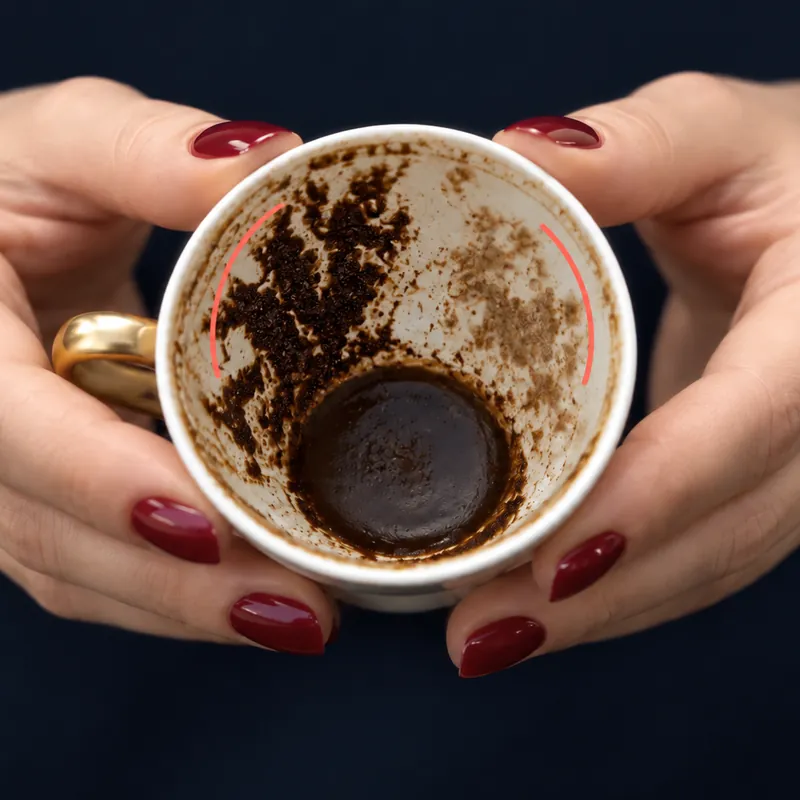
Thickness and Clarity
Clear, well-defined symbols indicate stronger influences, while faint or blurry patterns suggest subtle or uncertain influences.
Interpretation Practice
The art of reading coffee cups improves with practice. Start with clear symbols, then see how they relate.
Interpretation Tip
Note your first impressions; many readers treat them as a useful starting point.
Beginner Exercise
Photo Documentation
Take a photo of your cup from multiple angles to capture all symbols clearly.
Symbol Identification
Identify 3-5 prominent symbols that catch your attention first.
Intuitive Reflection
Reflect on how they might relate to your current situation before checking their traditional meanings.
Practice Guidelines
- 1
Start with obvious shapes and patterns before subtle details
- 2
Consider the emotional feeling each symbol gives you
- 3
Practice regularly to develop your intuition

How to take a good photo of your coffee cup
A white or pale cup makes the grounds easier to see, because dark shapes stand out against a light background. Photograph the cup near a window or in other soft, even light, keep your own shadow and the phone's reflection away from the inside, and avoid the flash.
Hold the phone slightly above the rim so both the walls and the bottom are visible, and take an extra picture from the opposite side if part of the cup is hidden. Photograph the saucer and the lid as well if grounds have run onto them. Never wipe or rearrange the grounds before the picture.
A photo reading can only work with what is actually visible: the shapes, their place between rim and bottom and the symbols around them. It never invents shapes that are not there.