An interpretation of your own grounds
The reading describes the shapes that are actually visible in the photo you took, so it is written for your cup alone.

Coffee cup reading, symbol by symbol
A heart, a road, a bird, a letter? Tasseography reads the shapes left in your cup, the same way tea leaves are read. Photograph your Turkish coffee grounds and see their traditional meanings for love, luck and what may lie ahead.
Every symbol meaning is free to explore. You start with welcome credits, and the full reading of your own cup is paid for with credits. Your reading stays private.
Four steps explain how to read coffee grounds, from your last sip to the symbols left inside the cup.
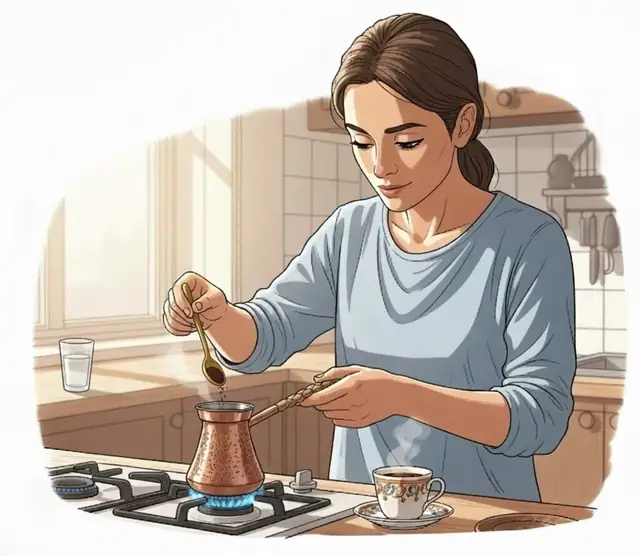
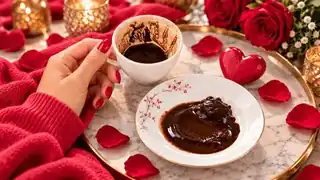
Leave the grounds in the cup, swirl it gently and turn it upside down on the saucer.
Photograph it together with the saucer and the lid. A frame on the screen shows you where to aim.
To read Turkish coffee grounds, look at each shape, where it sits and how it connects with the symbols around it.
Keep it in your own private history, or share it and hear how other people see the same grounds.
The reading describes the shapes that are actually visible in the photo you took, so it is written for your cup alone.
A heart, a bird, a ring, a road, a mountain. Explore Turkish coffee cup reading symbols and meanings, including what each shape has traditionally stood for and how its meaning shifts near the rim or down at the bottom.
See which shapes people connect with love, with someone on your mind, with a journey, with money or with news on its way.
It is written natively in your own language, in the everyday words your grandmother would have used at the table.
Everything you get belongs to you. You choose what to share, one reading at a time, and you can take it back.
Look at cups other people have shared, compare how the same shape is read from Istanbul to Sarajevo, and ask what a symbol might be.
People share their cups, point at a shape and ask what it could mean. You can follow the readers you like and compare how one symbol is read from one family to the next, which is an easy way to learn how to read coffee grounds and what each symbol in the cup means. Your own cup shows up here only if you decide to show it, and you can take it back whenever you want.
See what others found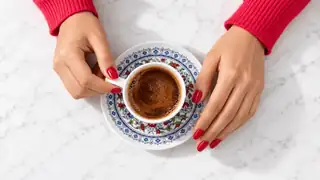


Cupfal is the link between authentic coffee spots and curious people who love coffee traditions. Register your café for free, get your unique QR code, and gain visibility in our directory across 41 languages. Guests discover the stories in their cup, tables stay lively, and your café gets free exposure at no cost.

After the last sip, coffee grounds can settle into shapes that look like a heart, a bird, a ring, a road or something else altogether. Reading those patterns is part of tasseography, the traditional practice of interpreting shapes left by coffee grounds or tea leaves. In coffee cup reading a symbol's position counts too, and readers usually tell apart signs near the rim, in the middle, at the bottom and around the handle. The symbols we read are listed below by category, each with its traditional meaning and notes on how its place in the cup can change the interpretation.
A heart in the cup is affection that is real and honest, and a romance that keeps growing deeper. Smooth and clearly drawn near the rim, it announces a happy…
A bird is news, and it usually travels fast. Flying upward it brings good tidings, an invitation or an answer you have been waiting for. A bird resting on a…
A fish is one of the best money signs in coffee cup reading, meaning plenty, a profitable windfall or good luck you did not expect. Swimming up toward the rim,…
The snake is one of the oldest warning signs in the cup. It points to deceit, envy, a hidden rival or words spoken behind your back, often by someone who…
A ring in a coffee reading means commitment: an engagement or marriage, or a partnership sealed by a binding contract. When the circle is closed and unbroken,…
The key is an opportunity, access to something new, or the solution to a problem. A clear key suggests answers are close. It may be a real key, like a new…
A tree in coffee reading is about deep family roots, a growing household and slow, steady growth in work and in life. A crown full of branches promises a…
The eye is awareness. Someone is watching, or you are about to see something you have not seen before. A clear open eye means insight, honesty and good…
A horse in the cup means strength, momentum and the kind of ambition you can be proud of. A galloping horse is fast progress at work, a win that is overdue or…
The cat is independence, mystery and instinct. It tends to show up when your gut has already told you something and you are busy arguing with it. A calm cat is…
The dog is loyalty. A friendly dog means a faithful friend, real support and a bond that lasts, and readers also see it as protection over the home. A barking…
The moon in coffee cup reading rules intuition, the ebb and flow of your feelings, and new beginnings with something mystical about them. A thin waxing…
Traditionally a heart stands for love and affection, the feelings that connect you to someone. A clear heart may point to strong feelings or a relationship that is becoming more important. Near the rim it usually…
Readers usually judge love from several symbols taken together. A heart may represent feelings, a ring commitment, two birds a meeting or conversation, and a key an opening or new possibility. When a few love-related…
Some coffee-reading traditions read an eye as attention, or as someone keeping you in mind, and a bird as a message or contact. When these symbols sit close to the handle, some readers relate them more strongly to…
A ring traditionally stands for a commitment of some kind: a partnership, an agreement or a promise. A clear, closed ring may show something becoming settled or formal. If the ring is open or incomplete, a decision or…
In the traditional reading a bird brings news and messages, or some other kind of communication. One that seems to be in flight may mean news arriving from a distance. Two birds facing one another usually point to a…
Readers commonly take a road or path as movement: a journey, a change or a decision about which way to go. A straight path may mean a clearer course ahead, and a winding one delays or detours. Where the path branches,…
An eye traditionally stands for attention and awareness. Depending on the reading tradition, it may represent someone watching a situation closely, attention from outside, intuition or the need to notice something you…
Traditionally a snake calls for caution. It marks a complicated situation, one that may not be as straightforward as it looks. Some readers see jealousy, hidden motives or tension in it; others see transformation and…
Finish the coffee, leave the grounds, swirl the cup and turn it upside down on the saucer for a few minutes. Then look at what the grounds left behind. This is the basis of Turkish coffee grounds reading and traditional Turkish coffee fortune telling. Shapes near the rim are read as what is close in time, shapes at the bottom as what lies deeper or further away. Photograph your cup and the shapes are pointed out and explained for you, one by one.
Tasseography is the practice of reading patterns left by coffee grounds or tea leaves in a cup. It grew out of Ottoman coffee culture and spread through the Balkans, Greece and the Middle East, where readers still interpret the same shapes and placements today. A reading looks at which symbols appear and where they sit between the rim, the middle and the bottom of the cup.
Both are tasseography and use the same symbols, such as the heart, bird, ring and road. Tea leaves are read from loose leaves left in the cup, while Turkish coffee leaves fine grounds that run down the sides when the cup is turned over. That gives clearer shapes and three zones to read: the rim, the middle and the bottom.
They share the same idea of reading signs, but each uses its own source. Tarot reads cards, palm reading reads the lines of the hand, and astrology reads the planets and your zodiac sign. A coffee cup reading looks only at the shapes in your own grounds, and zodiac signs can appear there as symbols too.
A heart is read as love and affection, often as feelings someone is holding for you, or feelings you are carrying yourself. Near the rim it usually means something happening soon. Broken or split, it is read as a bond under strain. Whatever sits beside it changes the story, so your reading takes in the shapes around the heart as well.
Birds are read as news and messages. A bird in flight usually means word arriving from far away, and two birds together mean a meeting or an understanding between two people. Where the bird sits and which way it faces are part of the reading.
The same way it works at the table, only the cup travels as a photo. Turkish coffee is brewed with its grounds, so when you turn the cup onto the saucer the grounds run down the sides and settle into shapes. Photograph the inside of the cup and each shape is named in turn, together with where it sits between rim and bottom, which is what a reader looks at first.
Yes. Photograph the cup, the saucer and the lid and you get a written reading of the symbols visible in your own grounds, the same way an experienced reader would tell your fortune in a coffee cup at the kitchen table, only without waiting for one to visit.
Every symbol in the cup and what it means is free to read. When you create an account you start out with welcome credits, so you can try your own cup. The full personal reading of that cup costs credits. There is no subscription and there are no hidden fees.
Cup reading is a tradition. Turkish, Balkan, Greek and Middle Eastern readers have interpreted the same shapes and placements for generations. Everything here is written in that spirit: something to think about and enjoy, not a statement of fact about your future.
Yes. Your photo and its interpretation land in your own private history and stay there. If you ever want to show one, you share it on purpose, and you can withdraw it again at any time.
No. It opens straight in your phone browser, and you can add it to your home screen if you want it one tap away. On a computer you can still read your history and look up symbol meanings, but the photos are easiest with a phone.
Turn it over, take a photo and find out what the grounds left for you.